
Video transcript
SCE Option D or E? One account in July: 50,000 kWh. Option E cuts demand charges from $5,901.20 to $2,001.40. Energy charges rise from $7,199.16 to $17,793.50.
July total: $13,854.10 on D. $20,548.64 on E. A lower-use account can flip. See both on our blog.
Short answer: SCE Option D charges more per kilowatt of peak demand and less per kilowatt-hour of energy. Option E flips that. On TOU-GS-2, Option D's facilities demand charge is $28.01 per kW versus $14.27 on Option E, but Option E's summer peak energy costs $0.75579 per kWh versus $0.19358 on Option D.
Who is this guide for?
This guide is for owners and managers of commercial buildings on SCE business rates. It compares Option D and Option E using SCE tariff sheets effective October 1, 2026. Every rate cites its Cal. PUC sheet number.
What is the main difference between Option D and Option E?
Option D puts more of the cost into demand charges, which are based on your highest 15-minute peak in kilowatts (kW). In return, its energy prices per kilowatt-hour (kWh) are lower. Option E has much lower demand charges but much higher energy prices, mostly on summer weekdays from 4 to 9 p.m.
On TOU-GS-2 and TOU-GS-3, Option D is the default (Sheets 91742-E and 91769-E). Option E is a choice the customer makes. On TOU-GS-1, for accounts up to 20 kW, Option E is the default (Sheet 91713-E). For how demand charges work, read commercial demand charges explained.
How do Option D and Option E compare on TOU-GS-2?
TOU-GS-2 covers accounts above 20 kW and below 200 kW. The table shows bundled rates below 2 kV, effective October 1, 2026. Both options share the $232.74 monthly customer charge, the $0.00864 per kWh Fixed Recovery Charge and the $0.00178 per kWh MCAM charge (Sheets 91745-E and 91746-E).
| TOU-GS-2 charge | Option D (Sheet 91745-E) | Option E (Sheet 91746-E) |
|---|---|---|
| Facilities-related demand, $/kW | $28.01 | $14.27 |
| Summer peak demand, weekdays 4–9 p.m., $/kW | $25.40 | $2.89 |
| Winter demand, weekdays 4–9 p.m., $/kW | $7.64 | $1.02 |
| Summer on-peak energy, weekdays 4–9 p.m., $/kWh | $0.19358 | $0.75579 |
| Summer mid-peak energy, weekends and holidays 4–9 p.m., $/kWh | $0.15430 | $0.48521 |
| Summer off-peak energy, all other hours, $/kWh | $0.12906 | $0.23041 |
| Winter mid-peak energy, 4–9 p.m. daily, $/kWh | $0.14330 | $0.22455 |
| Winter off-peak energy, 9 p.m.–8 a.m., $/kWh | $0.14586 | $0.15068 |
| Winter super-off-peak energy, 8 a.m.–4 p.m., $/kWh | $0.09102 | $0.11350 |
Each energy rate above is SCE delivery plus SCE power supply. For example, Option E summer on-peak is $0.42385 delivery plus $0.33194 power supply, which equals $0.75579 (Sheet 91746-E). Time periods come from Sheet 91750-E.
How do Option D and Option E compare on TOU-GS-3?
TOU-GS-3 covers accounts from 200 kW through 500 kW. Both options share the $1,188.00 monthly customer charge and the $0.00714 per kWh Fixed Recovery Charge (Sheets 91771-E and 91772-E).
| TOU-GS-3 charge | Option D (Sheet 91771-E) | Option E (Sheet 91772-E) |
|---|---|---|
| Facilities-related demand, $/kW | $31.85 | $15.16 |
| Summer peak demand, weekdays 4–9 p.m., $/kW | $29.90 | $3.60 |
| Winter demand, weekdays 4–9 p.m., $/kW | $9.85 | $1.38 |
| Summer on-peak energy, weekdays 4–9 p.m., $/kWh | $0.13121 | $0.70274 |
The pattern is the same as TOU-GS-2. Option E cuts demand charges and raises energy prices, most of all in summer peak hours.
Worked example: when does Option E cost more or less than Option D?
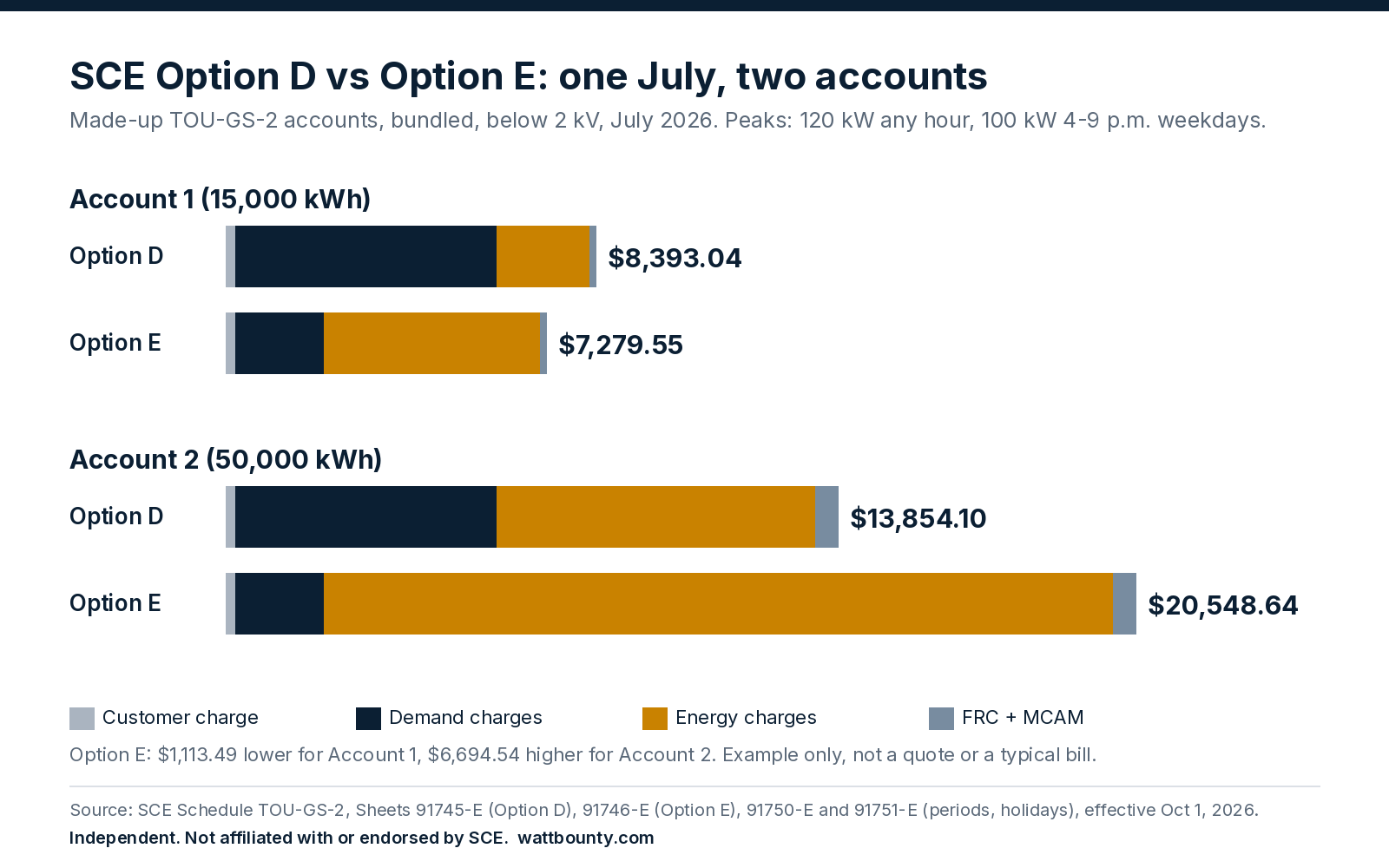
This example uses two made-up TOU-GS-2 accounts, bundled, below 2 kV, for calendar July 2026 (July 1 to 31) as the billing period. Rates come from Sheets 91745-E and 91746-E, effective Oct 1, 2026. Both accounts peak at 120 kW at any hour and 100 kW on weekdays from 4 to 9 p.m.
- Account 1 runs short bursts. It uses 15,000 kWh: 2,000 on-peak, 1,500 mid-peak and 11,500 off-peak.
- Account 2 runs long shifts. It uses 50,000 kWh: 10,000 on-peak, 4,000 mid-peak and 36,000 off-peak.
These kWh amounts fit the hours in July 2026. July has 23 weekdays and 8 weekend days. July 4 falls on a Saturday, and SCE does not move a Saturday holiday (Sheet 91751-E). So there are 115 on-peak hours (23 × 5), 40 mid-peak hours (8 × 5) and 589 off-peak hours. At 120 kW, the most a building can use in the 40 mid-peak hours is 4,800 kWh.
| July line (TOU-GS-2) | Account 1, Option D | Account 1, Option E | Account 2, Option D | Account 2, Option E |
|---|---|---|---|---|
| Customer charge | $232.74 | $232.74 | $232.74 | $232.74 |
| Demand: 120 kW × facilities rate + 100 kW × summer peak rate | $5,901.20 | $2,001.40 | $5,901.20 | $2,001.40 |
| Energy: kWh in each period × rate | $2,102.80 | $4,889.11 | $7,199.16 | $17,793.50 |
| FRC + MCAM: total kWh × $0.01042 | $156.30 | $156.30 | $521.00 | $521.00 |
| July total | $8,393.04 | $7,279.55 | $13,854.10 | $20,548.64 |
Here is the math for the demand line. On Option D: 120 × $28.01 = $3,361.20, plus 100 × $25.40 = $2,540.00, for $5,901.20. On Option E: 120 × $14.27 = $1,712.40, plus 100 × $2.89 = $289.00, for $2,001.40.
Here is the energy math for Account 1 on Option E: 2,000 × $0.75579 = $1,511.58, plus 1,500 × $0.48521 = $727.82, plus 11,500 × $0.23041 = $2,649.72. That adds to $4,889.11 after rounding.
Here is the energy math for Account 2. On Option D: 10,000 × $0.19358 = $1,935.80, plus 4,000 × $0.15430 = $617.20, plus 36,000 × $0.12906 = $4,646.16, for $7,199.16. On Option E: 10,000 × $0.75579 = $7,557.90, plus 4,000 × $0.48521 = $1,940.84, plus 36,000 × $0.23041 = $8,294.76, for $17,793.50.
In this one July, Option E is $1,113.49 lower for Account 1 and $6,694.54 higher for Account 2. The low-use account gains from lower demand charges. The high-use account pays much more for energy. This is an example, not a quote or a typical bill. It leaves out taxes, the California Climate Credit and other line items, and one summer month does not show a full year.
Who can choose SCE Option E?
On TOU-GS-2 and TOU-GS-3, the current schedules list Option E as one of the rate options, and Option D as the default (Sheets 91742-E and 91769-E). The Option E rules on these sheets do not list a solar or battery requirement. One limit is written in: customers on Critical Peak Pricing (CPP) under these schedules cannot also be on Option E (TOU-GS-2 Sheet 91754-E; TOU-GS-3 Sheet 91779-E).
The CPUC's 2026 rate design decision says Option E on TOU-GS-3 keeps its current rules, "which includes no eligibility restrictions" (Decision 26-04-033, page 36). An older SCE guide to Option E, dated May 6, 2025, describes different conditions. SCE confirms which options an account can use before any rate change.

Why does one month not settle the choice?
SCE has four summer months and eight winter months. Option E's energy prices are highest in summer peak hours, and the gap is smaller in winter. A fair comparison uses a full year of 15-minute meter data on both options.
What should you take away?
Option D and Option E sit in the same SCE tariff, but they suit opposite kinds of buildings. Option E tends to fit buildings with high peaks and low energy use, while Option D tends to fit buildings that run long hours. A building can sit on the default option for years without anyone checking the fit.
For the rate changes behind these numbers, see what SCE's October 2026 rate change means for businesses and how SCE time-of-use periods and demand charges work. For other bill drivers, see why a business electric bill is so high and why a business electric bill went up. If you want to know which option fits your building, contact us below.
Figures checked against SCE's published tariff sheets on October 30, 2026.
Frequently asked questions
Which option is the default on SCE business rates?
Option D is the default on TOU-GS-2 (Sheet 91742-E) and TOU-GS-3 (Sheet 91769-E). Option E is the default on TOU-GS-1 for accounts up to 20 kW (Sheet 91713-E).
How do I know if my building is on Option D or Option E?
Your SCE bill shows the rate schedule and option for each service account, for example TOU-GS-2-D or TOU-GS-2-E.
Who can choose Option E on TOU-GS-2 or TOU-GS-3?
The current TOU-GS-2 and TOU-GS-3 sheets list Option E as a rate option without a solar or battery requirement (Sheets 91742-E and 91769-E). Customers on Critical Peak Pricing under these schedules cannot also be on Option E (Sheets 91754-E and 91779-E). SCE confirms eligibility for each account.
Did Option E rates change after October 1, 2026?
SCE filed supplement 5897-E-A on October 19, 2026. It reissued TOU-GS-2 Option E Sheet 91746-E, effective Oct 1, 2026. The bundled summer on-peak energy rate on that sheet went from $0.78709 per kWh in the Sept. 29 filing to $0.75579 per kWh.
Do CCA customers see the same Option D vs Option E trade-off?
Partly. On TOU-GS-2 Option E, SCE's delivery part of the time-related demand charge is $0.00, but the delivery energy rate is higher, such as $0.42385 per kWh on summer weekdays from 4 to 9 p.m. (Sheet 91746-E). On Option D, that delivery energy rate is $0.04960 per kWh (Sheet 91745-E).
Sources & tariff citations
- SCE Schedule TOU-GS-2, Cal. PUC Sheets 91745-E (Option D), 91746-E (Option E), 91750-E (time periods), 91751-E (seasons), 91755-E (demand rules), effective Oct 1, 2026. Open SCE Tariff Books, then General Service/Industrial Rates (accessed 2026-10-30)
- SCE Schedule TOU-GS-3, Cal. PUC Sheets 91771-E (Option D) and 91772-E (Option E), effective Oct 1, 2026. Open SCE Tariff Books, then General Service/Industrial Rates (accessed 2026-10-30)
- SCE Schedule TOU-GS-1, Cal. PUC Sheets 91713-E (options), 91716-E (Option E) and 91717-E (Option D), effective Oct 1, 2026. Open SCE Tariff Books, then General Service/Industrial Rates (accessed 2026-10-30)
- SCE Advice Letter 5897-E (submitted Sept 29, 2026) and supplement 5897-E-A (submitted Oct 19, 2026), effective Oct 1, 2026, under CPUC Decision 26-04-033 (accessed 2026-10-30)
- CPUC Decision 26-04-033 (April 30, 2026), SCE 2025 General Rate Case Phase 2 (accessed 2026-10-30)
- SCE tariff books: commercial rate schedules (accessed 2026-10-30)
Related guides
- What SCE's October 1, 2026 rate change means for businesses
SCE changed business rates on Oct 1, 2026. CPP is now optional, Option DD opens for qualifying energy storage, and demand, customer and energy charges shifted. - How SCE time-of-use periods and demand charges work for businesses
A plain guide to SCE's peak hours for business rates and how the two kinds of demand charges are billed, using rates in effect Oct 1, 2026. - Why is my business electric bill so high?
Business electric bills are high for reasons beyond how many kWh you use. Demand charges, rate class, peak hours and who supplies your power all matter. - Why did my business electric bill go up?
A business electric bill can rise after a rate change, the June 1 season switch, one demand spike or a longer billing cycle. Here is what those changes mean. - What is a demand charge? SCE business demand charges explained
What is a demand charge? It is the part of a business bill set by your peak kW. See how SCE measures it, with a worked TOU-GS-2 example at Oct 1, 2026 rates.